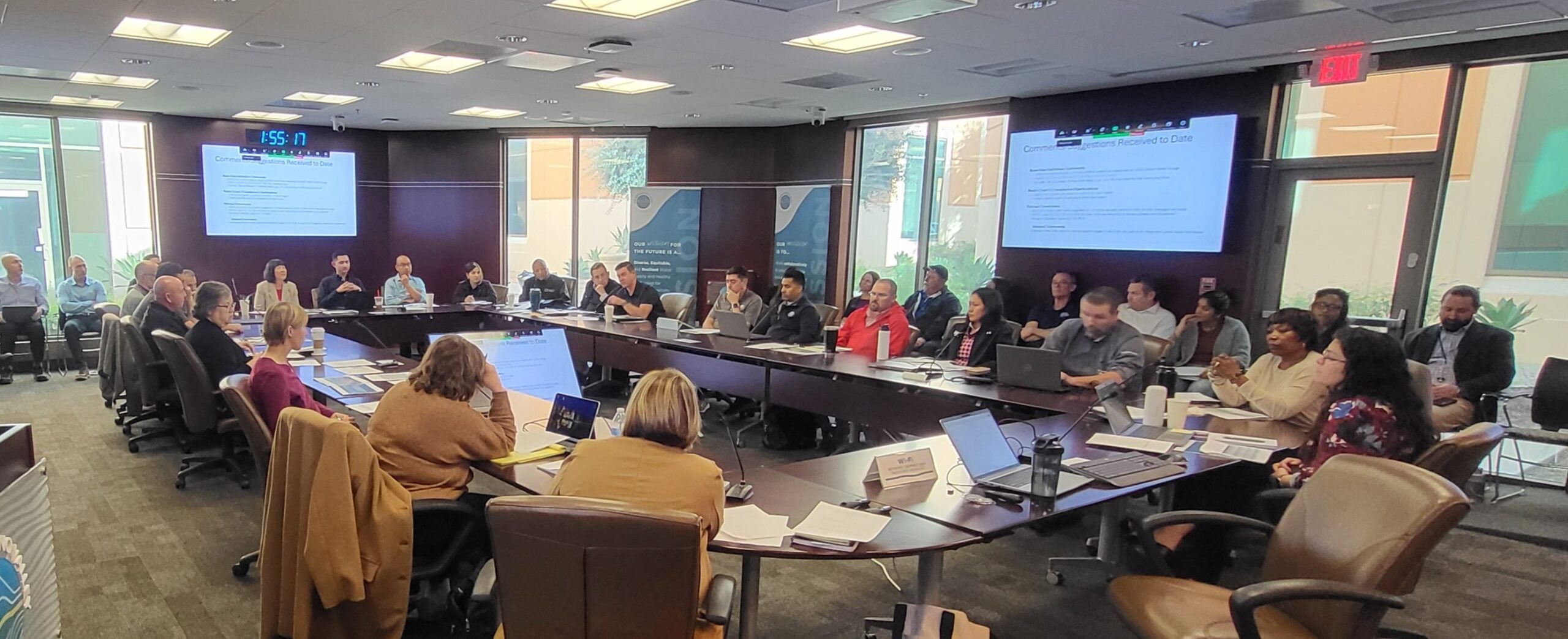
As an outgrowth of the Nitrogen/TDS Task Force, the agencies responsible for implementing the Basin Plan Amendments formed the Basin Monitoring Task Force, and SAWPA was identified to administer/facilitate that effort.
The Basin Monitoring Program Task Force was formed in August 2004 and consist of 20 water agencies Task Force members and the Santa Ana Regional Water Quality Control Board as an Advisory Member. The Task Force compiles and collects monitoring data to evaluate the water quality of the Santa Ana River on an annual basis, and the groundwater basins throughout the watershed every five years. The water agencies responsible for completing these tasks were included in the RWQCB Basin Plan as a result of the January 2004 Nitrogen and Total Dissolved Solids Basin Plan Amendment.
The Task Force is administered by SAWPA and meets bi-monthly. The primary work tasks include the following:
Preparation of an annual water quality report for the Santa Ana River Reaches 2, 3, 4 & 5 necessary to assure compliance with both surface water objectives of the defined river reaches.
Preparation of a watershed-wide TDS/Nitrogen ambient water quality update every five years to determine the current ambient groundwater quality in the watershed for TDS/Nitrogen.
The Task Force has also led past updates of the Santa Ana River waste load allocation model. In short, waste load allocations distribute a share of total TDS and Nitrogen wasteloads to each of the publicly owned treatment works (POTWs) that discharge treated wastewater to the Santa Ana River and its tributaries.
These reports fulfill the requirement to prepare an Annual Report of Santa Ana River Water Quality pursuant to the 2004 Basin Plan Amendment. Contained within these reports are water quality data required to implement the surface water monitoring program necessary to determine compliance with the nitrogen and TDS objectives of the SAR and, thereby, the effectiveness of the wasteload allocations.
Recomputation of Ambient Water Quality (AWQ) Reports
As part of the agreement to adopt the 2004 Basin Plan amendment, the Task Force has agreed to recompute ambient water quality for individual management zones every five years. The determination of current ambient quality shall be accomplished using methodology consistent with that employed by the TIN/TDS Taskforce (20-year running averages) to develop the TDS and Nitrate water quality objectives included in the 2004 Basin Plan.
Santa Ana River Wasteload Allocation Model (WLAM) Reports
Wasteload allocations for regulating discharges of TDS and total inorganic nitrogen (TIN) to the Santa Ana River, and thence to groundwater management zones recharged by the River, are an important component of salt management for the Santa Ana Basin.
2019 Santa Ana River Wasteload Allocation Model Summary Report
We use cookies to give you the most relevant experience by remembering your preferences and repeat visits. By clicking “Accept”, you consent to the use of all cookies.
sawpa.org uses cookies to improve your experience while you navigate through the website. Out of these, the cookies that are categorized as necessary are stored on your browser as they are essential for the working of basic functionalities of the website. We also use third-party cookies that help us analyze and understand how you use this website. These cookies will be stored in your browser only with your consent. You also have the option to opt-out of these cookies. But opting out of some of these cookies may affect your browsing experience.
Necessary cookies are absolutely essential for the website to function properly. This category only includes cookies that ensures basic functionalities and security features of the website. These cookies do not store any personal information.
Any cookies that may not be particularly necessary for the website to function and is used specifically to collect user personal data via analytics, ads, other embedded contents are termed as non-necessary cookies. It is mandatory to procure user consent prior to running these cookies on your website.
Functional cookies help to perform certain functionalities like sharing the content of the website on social media platforms, collect feedbacks, and other third-party features.
Performance cookies are used to understand and analyze the key performance indexes of the website which helps in delivering a better user experience for the visitors.
Analytical cookies are used to understand how visitors interact with the website. These cookies help provide information on metrics the number of visitors, bounce rate, traffic source, etc.
Cookie
Duration
Description
CONSENT
2 years
YouTube sets this cookie via embedded youtube-videos and registers anonymous statistical data.
Advertisement cookies are used to provide visitors with relevant ads and marketing campaigns. These cookies track visitors across websites and collect information to provide customized ads.
Cookie
Duration
Description
VISITOR_INFO1_LIVE
5 months 27 days
A cookie set by YouTube to measure bandwidth that determines whether the user gets the new or old player interface.
YSC
session
YSC cookie is set by Youtube and is used to track the views of embedded videos on Youtube pages.
yt-remote-connected-devices
never
YouTube sets this cookie to store the video preferences of the user using embedded YouTube video.
yt-remote-device-id
never
YouTube sets this cookie to store the video preferences of the user using embedded YouTube video.